Step 1
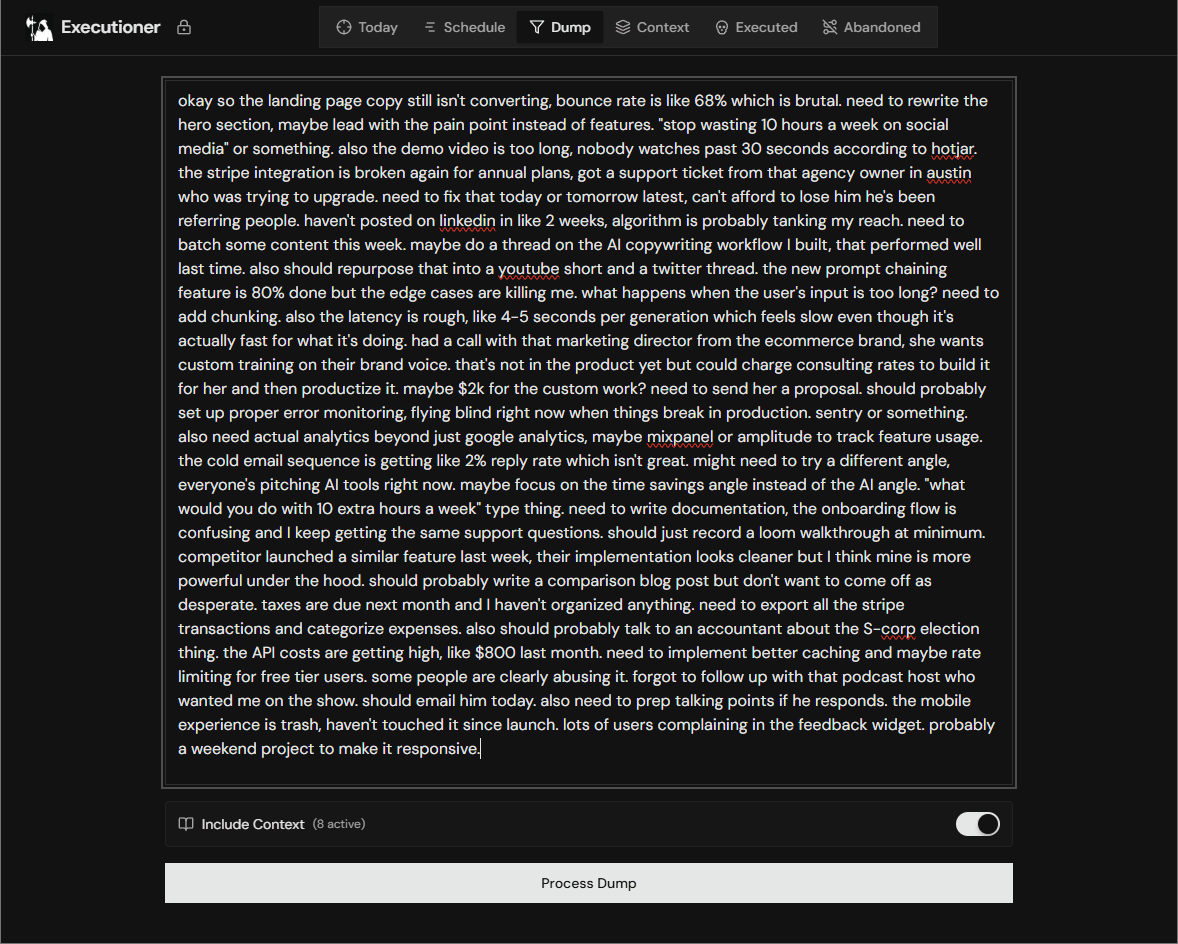
Brain Dump
Put everything on your mind in one place. Unfinished thoughts. Loose obligations. Things you've been avoiding.
You don't need to be clear.
Automated scheduling based on your constraints.
Put everything on your mind in one place. Unfinished thoughts. Loose obligations. Things you've been avoiding.
You don't need to be clear.
Executioner schedules the outcomes so you don’t have to. Your blocked dates are protected. Priority work comes first.
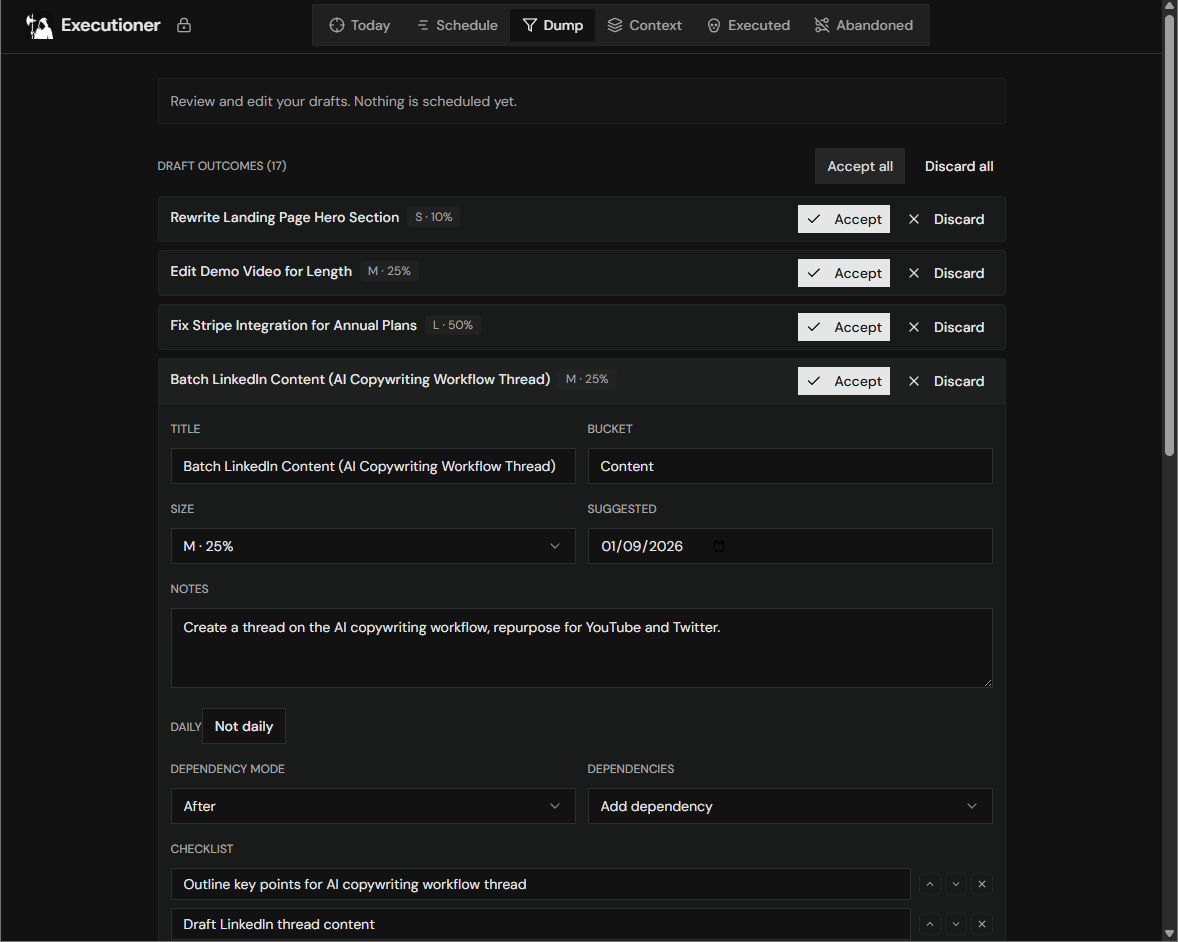
You check once per day. You execute what's scheduled. Nothing else matters.
No motivation. No rewards. Just execution.

Executioner is not a productivity app. It does not help you plan, optimize, or feel productive.
It does not motivate you. It does not reward you. It does not remind you to do the work.
Executioner assumes responsibility. It provides clarity and expects execution.
If that sounds uncomfortable, this isn't for you.

Executioner removes the decision layer.
If a day is blocked, nothing is scheduled on it.
If a day has limited availability, less work is scheduled. Nothing is forced in.
If an outcome is daily, it is scheduled first every day it applies.
Every outcome has an execution size: 5%, 10%, 25%, or 50% (XS, S, M, L).
Higher-importance outcomes are scheduled earlier. Lower-importance outcomes are deferred when space runs out.
When a day reaches its limit, no additional work is added.
After scheduling, outcomes remain editable.
You can resize, move, or discard them.
Executioner sets the structure.
You retain final authority.
Context View defines the rules the system operates under.
Once set, those rules are enforced every day.
Work is strictly segregated by type to prevent context switching. Buckets contain the noise; they do not mix.
Playbooks define how outcomes in a bucket are scheduled, pressured, or limited.
Some rules apply to all outcomes, regardless of bucket.
You do not manage outcomes day to day.
The system applies the rules. You operate inside them.

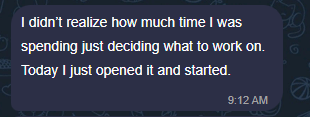
Most people do not fail because they are lazy. They fail because they spend too much time deciding. Modern tools encourage endless thinking: reorganizing tasks, rewriting plans, refining systems. All of this feels productive, but none of it finishes work.
If a tool gives you more ways to think about work than to do it, it is the problem. They sell the feeling of control while increasing cognitive load. They confuse flexibility with effectiveness.
Executioner assumes you are capable. It does not motivate. It does not reward. It is a decision-removal system for people who are tired of negotiating with themselves. If the system decides, you can act. You do not wake up asking what to do. You wake up knowing.
"Executioner replaces negotiation with commitment. That is the entire reason it exists."
A simple decision. No complex tiers.
Full access after free trial. Cancel before trial ends.
Same decision system. Fewer billing decisions. Cancel before free trial ends.
No trial. One-time payment. Future updates included. Available to the first 150 users.
Lifetime access exists to fund dedicated development. It will not be offered again.
Ongoing refinement of how the system behaves.
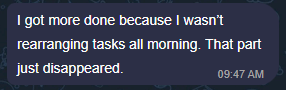 Freelance Writer
“It feels quieter in my head.”
SaaS Founder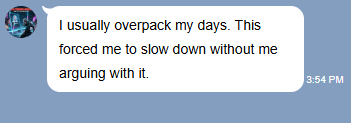 CTO
CTO
 Growth Marketer
“I don’t second-guess my day anymore.”
Agency Founder Indie Hacker
 Operations Manager
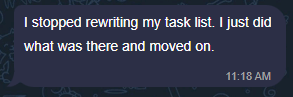
“My task list stopped changing.”
Senior Developer Engineering Lead
 Creative Director
“I spend less time planning and more time working.”
Product Designer Startup Founder
Executioner is a decision. Subscription plans include a free trial. Lifetime plans include a 7-day money-back guarantee. No questions asked.
Cancel before trial ends. No extensions.
Yes. A free trial is available on subscription plans.
Because execution requires commitment. Free tools don't get used.
Nothing. Executioner does not chase you.
No. Responsibility is assumed.
No. Excess choice is removed on purpose.
No. It's a personal execution system.